
 Nederlands
 English
 Français
 Deutsch
 Ελληνικά
 Italiano
 Português
 Русский
 Español
 Türkçe
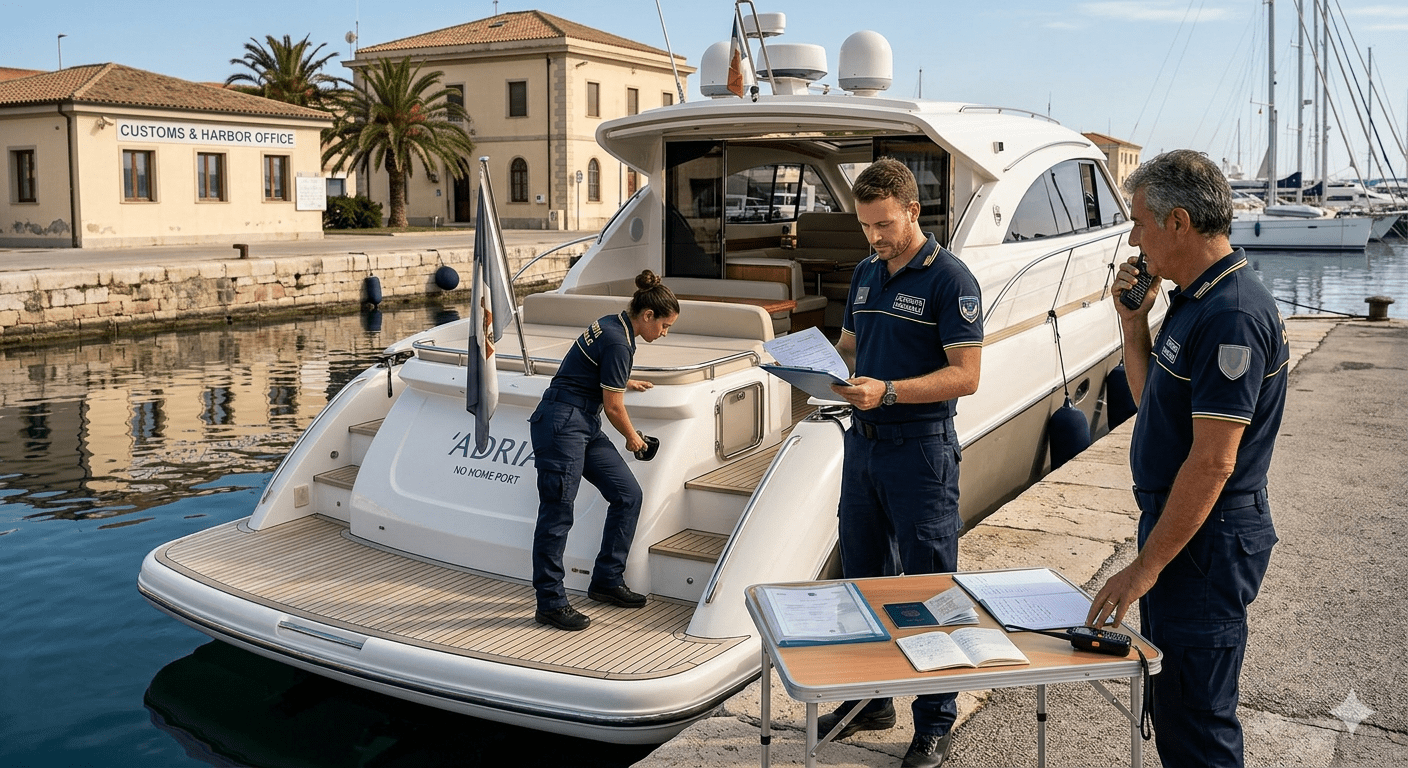
If you own a yacht that is not EU VAT paid and you plan to cruise in European waters, the flag your boat flies can matter more than you might expect. For some owners, choosing an EU registration can actually create questions at customs, while a non-EU registration such as San Marino can make the picture much clearer.
This article explains, in plain language, what that means, why it matters, what your options are, and what you should do next. It is written for yacht and boat owners without a legal or tax background.
What Does “VAT Status” Mean for a Yacht?
When a yacht enters EU waters, customs authorities want to know one key thing: has VAT already been paid on this vessel inside the EU?
If the answer is yes, the yacht has what is often called EU VAT-paid or Union status. In that case, the boat can generally move around EU waters without customs questions about import VAT.
If the answer is no, the situation is different. The yacht is treated as a non-EU vessel. That does not automatically mean VAT is owed, but it does mean the owner needs to fit within a specific framework to cruise in EU waters without paying import VAT. That framework is called Temporary Admission.
Temporary Admission allows non-EU yachts, owned and used by people established outside the EU, to remain temporarily in EU waters without paying import VAT. There are conditions, and there is a time limit. The rules form part of the EU customs framework for means of transport.
Why the Choice of Flag Can Create a Problem
A common misunderstanding is that the flag alone decides whether VAT is due. That is not correct.
If your yacht already has valid EU VAT-paid status, the flag usually does not create a VAT problem. An EU registration such as a Polish or Dutch registration generally works fine in that situation.
The picture changes when the yacht is not EU VAT paid and the owner is established outside the EU.
In that case, customs authorities expect to see a vessel that clearly fits the structure of a non-EU yacht temporarily visiting EU waters. If the same yacht carries an EU flag, the file can look inconsistent. The vessel appears to be EU-based, even though the owner is relying on rules designed for non-EU boats.
This does not automatically trigger a VAT bill. But it can raise questions during an inspection, lead to extra document requests, and slow down your cruising plans.
Why San Marino Is Different
San Marino is treated as a non-EU country for customs purposes, even though it has a customs union relationship with the European Union. It is European, a member of the International Maritime Organization, and aligned with the OECD white list.
Registering your yacht in San Marino does not trigger EU VAT liability. The vessel keeps its non-Union status, which means it fits more naturally within the Temporary Admission structure.
In practice, when a non-EU owner moves a yacht from an EU registration to San Marino:
- The yacht clearly carries a non-EU flag.
- The registration aligns better with the Temporary Admission framework.
- The vessel’s legal position becomes easier to explain to customs authorities.
For owners relying on Temporary Admission, that alignment can make a real difference.
What San Marino Registration Does Not Do
It is important to be honest about the limits. Changing your flag does not automatically remove all VAT risk.
Customs authorities may still look at the whole picture, including:
- Whether the yacht already has EU VAT-paid status.
- Where the owner is legally established.
- Who is actually operating the yacht.
- How long the yacht remains in EU waters.
- Whether the correct documentation is on board.
If those elements do not fit the Temporary Admission rules, questions can still arise, whatever flag you fly. Registration is not the same as tax advice, and a registration agent cannot restructure your tax position for you.
What San Marino can do is place a correctly structured file in a much cleaner and more defensible position.
A Practical Example
Imagine a non-EU owner with a yacht that is not EU VAT paid. The owner plans to cruise the Mediterranean for around 12 months. Under Temporary Admission, this is generally possible if the owner is established outside the EU and the yacht qualifies as a non-EU vessel.
If the yacht is registered under an EU flag, customs officers may ask why an EU-flagged vessel is being used under Temporary Admission rules. The registration does not match the vessel’s non-EU status, which can lead to extra document requests and delays.
If the same yacht is registered in San Marino, it clearly presents as a non-EU vessel. The flag supports the Temporary Admission position instead of working against it. The owner can cruise with greater confidence, knowing the paperwork tells a consistent story.
Your Options and What San Marino Registration Costs
BlueWater Registration Services arranges San Marino registration for the following categories. All prices are starting prices, exclude VAT, and depend on the specific characteristics of your yacht and the documentation required.
- Private use, boats from 1 m up to (not including) 10 m: from €1,540 excl. VAT. Includes a Registratiebewijs valid for life and a San Marino Resident Agent.
- Private use, boats from 10 m up to (not including) 24 m: from €2,640 excl. VAT. Includes a Registratiebewijs valid for life, MMSI Radio License, Safety Certificate and San Marino Resident Agent.
- Commercial use, boats from 1 m up to (not including) 24 m: from €3,450 excl. VAT. Includes a Commercieel Registratiebewijs, MMSI Radio License, Safety Certificate, San Marino Resident Agent and Minimum Safe Manning Document.
- Private use, boats from 24 m: from €6,440 excl. VAT. Includes a Registratiebewijs valid for life, MMSI Radio License, Safety Certificate, Tonnage Certificate and San Marino Resident Agent.
Please note that San Marino registration is not available for boats outside the categories listed above. If your vessel falls outside these ranges or uses, this option does not apply to you, and other registration routes may be more appropriate.
For most pleasure yachts under 24 metres, no inspection is required. The process relies on standard pleasure yacht documentation and compliance with the San Marino maritime code. In many cases, registration can be completed in approximately two working days after a complete dossier is submitted.
Common Mistakes to Avoid
Owners often run into the same problems. Watch out for these:
- Assuming the flag alone decides VAT. It does not. The owner’s status, the yacht’s history and the cruising pattern all matter.
- Ignoring the yacht’s customs and import history. Where the boat has been and whether VAT was ever paid are central questions.
- Confusing registration with tax advice. A registration agent handles the flag and the documents. VAT conclusions require a proper review of your file, ideally with a qualified tax advisor or customs expert.
- Leaving the decision until the last minute. Once a yacht is already cruising in EU waters, changing the structure becomes much more complicated.
What You Should Do Next
If you are a non-EU owner with a yacht that is not EU VAT paid, and you plan to cruise in EU waters under Temporary Admission, the sensible first step is to have your file reviewed before you commit to a flag.
Gather the basics: your yacht’s length and intended use, your own residency and establishment status, the yacht’s VAT and import history, and your cruising plans for the coming season. With those details, it becomes much easier to see whether San Marino registration fits your situation or whether another option suits you better.
Planning early helps you avoid customs questions, operational disruption and unexpected VAT exposure later on.
Conclusion
An EU registration is not wrong in itself. For yachts with EU VAT-paid status, it is often the simplest and best choice. But for non-EU owners with yachts that are not EU VAT paid, an EU flag can sit awkwardly with the Temporary Admission framework and invite unnecessary questions.
San Marino offers a non-EU, European, IMO-member registration that keeps the vessel’s non-Union status intact and aligns cleanly with Temporary Admission. It does not replace proper tax advice, and the full compliance file still matters. But when the circumstances are right, it puts your yacht in a clearer and more defensible position.
BlueWater Registration Services can assist with further guidance and can review your yacht’s details to confirm whether San Marino registration is the right fit. If you would like a personalised assessment of your file, simply get in touch with our team.